
Family Mediation
Barker Family Mediation
Family life is full of the people we love most — and sometimes, the conversations that are hardest to have. When things feel stuck, or communication has broken down, mediation gives families the space they need to start talking again. Calmly. Honestly. And on their own terms.
"Families rarely want confrontation. What most people are really looking for is a way to communicate respectfully and move forward with their dignity intact."— The Foundation of Family Mediation
Welcome

Even in the most loving families, things can get complicated. Relationships shift over time. Stress builds up quietly. Circumstances that once felt manageable can start to feel overwhelming — and conversations that used to come easily can suddenly feel impossible. That is not a sign that something is irreparably wrong. It is simply part of what it means to be a family trying to navigate real life together.
Family mediation exists for exactly these moments. It is not about deciding who is right or who is to blame. It is about creating a space where people can speak honestly, listen without the conversation turning into an argument, and start working toward something that actually makes sense for everyone involved — not just on paper, but in the day-to-day reality of how the family actually lives.
What mediation does particularly well is help people look forward rather than getting pulled back into old grievances. Instead of going over past hurt, the focus turns to what practical arrangements, new patterns of communication, and shared understandings will allow everyone to move ahead — with less tension, more clarity, and a genuine sense of mutual respect that both sides can feel.
"When families learn to talk about difficult things in a calm and supported way, they often discover that most situations are far more manageable than they seemed at first. Mediation creates the conditions that allow that kind of conversation to happen — and happen well."
Why It Matters
It is easy to assume that families should just be able to sort things out between themselves. And sometimes they can. But when emotions are running high and communication has already started to break down, trying to navigate things without any support can easily make the situation worse rather than better. Having a trained, professional mediator involved changes the dynamic entirely — in ways that are often surprising to the people who experience it for the first time.
A mediator has no stake in the outcome and no side to take. Their entire job is to make sure the conversation stays balanced — that both people genuinely get heard, and that neither voice gets lost in the noise of an emotionally charged discussion. That neutrality is rarer and more valuable than it might first seem.
Without any structure, family disagreements tend to spiral. People interrupt, misread each other's intentions, or shut down and go quiet altogether. Mediation gives the conversation a shape — a clear format where people speak with intention, listen fully without jumping in, and stay focused on what actually needs to be resolved rather than rehashing what has already gone wrong.
One of the most important things about mediation is that no one imposes a solution from the outside. Unlike a court process, where decisions are made by people who have never met your family and do not understand your daily reality, mediation keeps the decision-making exactly where it belongs — with the people who actually understand the situation and will live with the outcome.
The Process

If you have never been through mediation before, it is completely natural to feel uncertain about what to expect. Most people arrive not quite knowing what they are walking into. Knowing how the process tends to unfold — step by step, in plain terms — can make it feel a great deal less daunting and help everyone arrive feeling a little more at ease before things begin.
Things usually begin with an introductory call or meeting. This is simply a chance to get acquainted — the mediator explains how the process works, walks through what people can expect, and makes sure there is space for questions or concerns before anything formal begins. There is no commitment, no pressure, and no expectation at this stage. It is genuinely just about understanding what mediation involves and whether it feels like the right step.
Before any joint sessions take place, each person typically meets with the mediator separately. This is a genuinely private space — a chance to say what is really on your mind, explain what matters most to you, and think through what you actually want from the process without feeling observed or judged. There is no performance required, no need to hold anything back. These individual meetings tend to make the shared sessions that follow far more productive, because everyone arrives already having had room to prepare themselves and get clear on what they need.
When everyone feels ready, the shared sessions start. The mediator guides the conversation carefully — keeping things moving, making sure each person gets a proper turn to speak, and gently steering the discussion back on track if it starts to lose its way. What gets talked about depends entirely on what the family needs: parenting arrangements, finances, how important decisions will be made, how communication between households will work day to day. These are the kinds of conversations that mediation creates the conditions for having well.
As the conversations develop, things that felt vague, stuck, or impossible begin to crystallise into actual, workable proposals. The mediator helps translate discussion into clear, specific agreements so that everyone leaves the room knowing exactly what has been decided and what comes next. Nobody gets rushed. There is time to sit with options, consider them from different angles, and make sure that what gets agreed genuinely fits the family's actual life — not just what seemed easiest or most logical in the moment of discussion.
Once agreements have been reached, families leave with something genuinely tangible — a clearer shared understanding, specific plans for how things will work going forward, and often a renewed sense of what co-operating can actually look like in practice. Many families also find that the way they have learned to communicate during mediation does not stay neatly inside the room. It carries forward into daily life, making future difficult conversations feel a little less impossible than they once did — and a little less like something to be dreaded.
Who It Is For
There is no single type of family that mediation is built for. It works across a wide range of different situations and circumstances. What tends to matter most is not whether people are in full agreement — they often are not — but whether they are willing to try talking things through, even when they are not sure how it will go or whether it will feel worth it.
When a relationship ends or changes in a significant way, there is suddenly a great deal to work through — where children will live, how time gets shared between households, how day-to-day decisions get made. Mediation gives parents a supported, structured way to work through all of that without it having to turn into a prolonged fight.
Even when parents are no longer together, they continue to share the most important responsibility of their lives. Mediation helps co-parenting relationships find a working rhythm — one that is built on clearer communication, shared expectations, and far less room for misunderstanding to quietly build and then suddenly erupt.
Merging households, managing step-parent relationships, and navigating the presence of grandparents and other extended family members can be genuinely complex. Mediation creates a space to talk through those dynamics with care and consideration — making room for everyone who plays a meaningful role in the lives of the children involved.
Sometimes things deteriorate gradually — not through one single falling-out, but through years of small misunderstandings, things left unsaid, and conversations that never quite happened. For families who have ended up in a place of painful silence or repeated, unresolved conflict, mediation can offer a genuine way back into dialogue.
Mediation does not have to wait for a crisis before it becomes useful. Some families use it as a proactive way to have the conversations that might become difficult if left too long — working through emerging tensions, getting clearer on expectations, and establishing better communication habits before things reach a breaking point that is much harder to come back from.
A move, a significant financial change, a health issue, a shift in a child's circumstances or needs — any of these can put real pressure on family relationships in ways that are genuinely hard to navigate alone. Mediation provides a thoughtful, supported space to talk through how those changes affect everyone and what adjustments realistically need to be made.
Areas We Cover
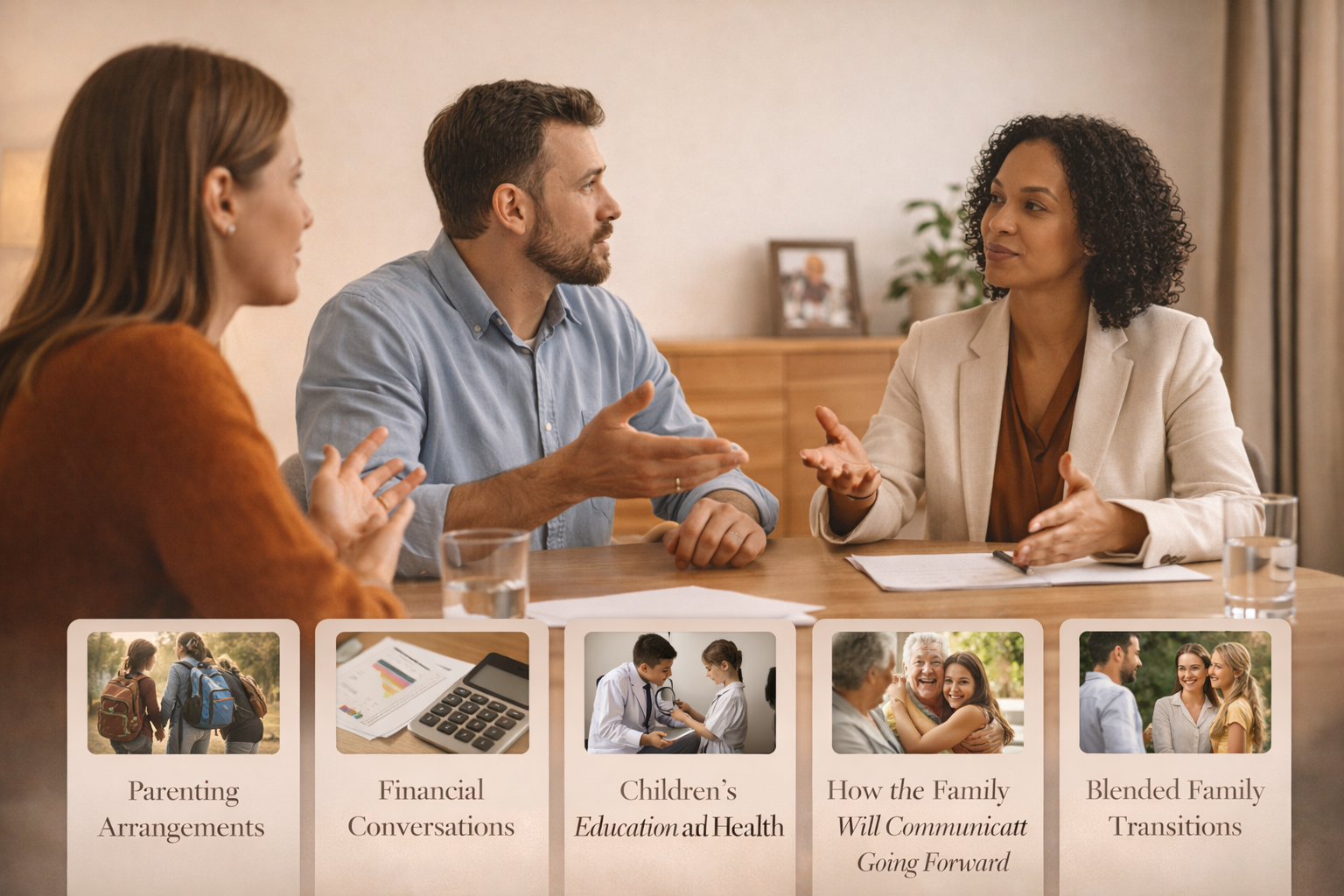
Family mediation is flexible by design. The conversations that happen are shaped entirely by what the family sitting in the room actually needs — not a rigid, predetermined checklist that everyone has to work through in the same order. That said, there are certain areas that come up again and again, because they are the things that matter most to families and are genuinely hard to talk through without some structure and support around them.
Where children will live, how time between two households gets divided, who takes responsibility for school and medical appointments, what the holiday schedule looks like, and how parents communicate with each other about the children on a day-to-day basis. These are often the most emotionally charged conversations that a family going through change will have — and the ones where having mediation support tends to make the biggest practical difference.
Money is one of the most sensitive areas in any family situation, and especially so after separation. Decisions about housing, the division of shared finances and assets, maintenance arrangements, and longer-term financial planning all sit here — and mediation gives those conversations the structure they need to be productive and clear, rather than becoming a source of additional pain and conflict on top of everything else.
Parents do not always see things the same way when it comes to school choices, medical decisions, or what they hope for their children's futures. These are not small matters, and getting them right matters enormously. Mediation makes room for both parents to express what they genuinely want for their children, and helps them work toward decisions they can both stand behind with confidence and consistency.
Reaching practical agreements is important — but agreeing on how the family will actually communicate with each other after separation is often just as significant in the long run. How will changes in plans be shared? How will disagreements be raised without things immediately escalating? What does respectful co-operation look like in practice, and how do you build habits that make it sustainable? These are conversations mediation helps families have before those situations arise and catch everyone off guard.
Grandparents, step-parents, aunts and uncles, close family friends — the people beyond the immediate household often play a significant and deeply meaningful role in a child's life. When family structures change, those relationships can come under pressure they were never designed to bear. Mediation gives space to acknowledge those relationships honestly and to think carefully about how they can be maintained, respected, and supported through the transition.
Bringing two family units together asks a great deal of everyone involved — adults and children alike. New routines need to be found. New relationships need time and care to develop. Children need reassurance and genuine consistency even as so much around them is changing at once. Mediation creates a calm, considered space for those conversations to happen in a way that is thoughtful, patient, and genuinely focused on what everyone needs rather than what might be most convenient.
What It Feels Like
For many people, the biggest obstacle to taking the first step toward mediation is simply not knowing what it will feel like to walk in. The honest answer is that it is far less intimidating than most people imagine. Sessions are calm, carefully structured, and paced entirely to suit the family — not rushed, not confrontational, and nothing like an adversarial legal setting. Here is what the experience genuinely tends to look like in practice for most families.
It is worth being clear about what a mediator is not — they are not a judge, they are not a counsellor, and they are certainly not there to tell anyone what to do or how to feel. They are a skilled, experienced, neutral presence — someone whose sole job is to help people in the room talk to each other more effectively, and to support the conditions that make real agreement genuinely possible.
They ask questions that help clarify what matters and why. They help reflect back what has been said so that everyone is truly on the same page. They notice when the conversation needs redirecting and they find ways to keep things moving when they get stuck — which they sometimes do, because this is real life and real people.
The decisions that come out of mediation belong entirely to the people sitting in the room. The mediator creates the space and the conditions. The family makes the choices.
What You Can Realistically Expect
Mediation is not a magic fix, and it would not be honest to suggest otherwise. It does not guarantee that every family will come away in perfect agreement on every issue — that is simply not how it works. What it does offer is a genuine, properly supported process that makes meaningful progress far more likely than trying to handle things without any help at all. Here is what families most commonly take away from it.
Very often, people leave mediation with a real, lived sense of where the other person is coming from — not necessarily agreeing with them, but understanding them in a way that makes future conflict far less likely and far less intense than it would otherwise be.
Families tend to reach specific, workable arrangements on the things that matter most — parenting, finances, communication — that reflect who they actually are and how they actually live, not some idealised version of what the situation should look like from the outside.
When communication genuinely improves, the intensity and frequency of disagreements tends to go down over time. Not because every issue disappears, but because people have learned better ways of handling those issues without them automatically escalating into something much bigger and more damaging.
Perhaps the most lasting benefit is the communication pattern that gets established. Many families find that the habits built during mediation stay with them long after — making future hard conversations feel manageable rather than something to be avoided at all costs.
Standards and Safety
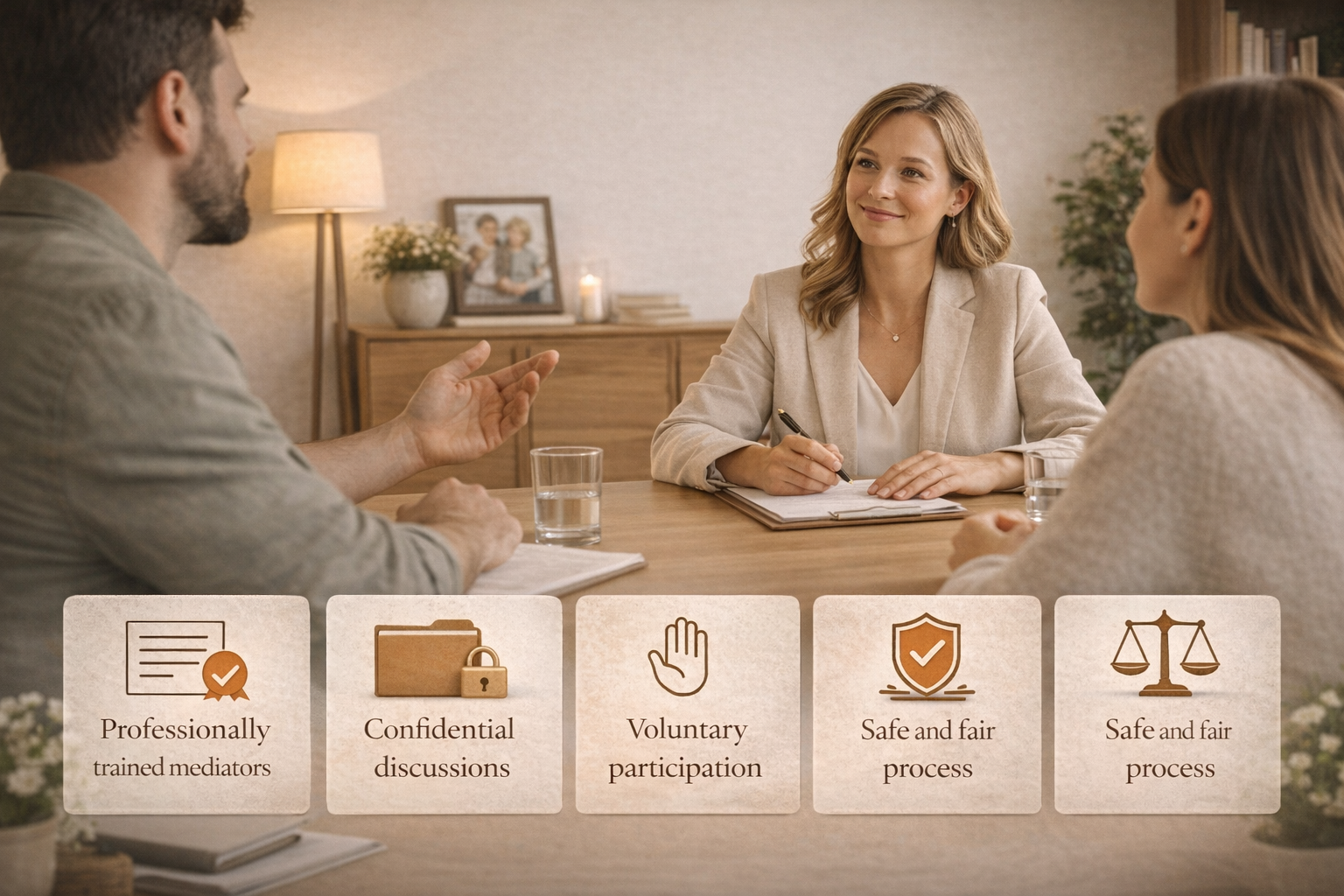
For mediation to actually work, everyone involved needs to feel genuinely safe — not just in a physical sense, but safe enough to speak honestly, to let emotion show, and to say things out loud that might feel vulnerable or uncomfortable. That kind of safety does not happen on its own. It is built deliberately into the structure of the process, and it is upheld throughout by the professional standards and ethics that every trained mediator works to.
All mediators are professionally trained and operate within a clear, well-established code of professional ethics and conduct.
What is discussed in sessions is entirely confidential — it stays in the room and simply cannot be used against either party in any other context.
Participation is always voluntary. Nobody is ever required to continue with the process if at any point it stops feeling right for them.
The mediator actively manages the tone throughout — stepping in if discussions become unproductive and consistently ensuring that the conversation remains balanced and fair to everyone in the room.
After Mediation

The end of a mediation process is not the end of the work — if anything, it is where the most important results begin to show up. The agreements reached during sessions and the different ways of communicating that families develop together do not stay neatly contained inside the mediation room. They travel home with people, and they continue to shape how the family functions in ways that are sometimes quiet and sometimes profound.
One of the quieter but genuinely important things that happens in mediation is that people learn a different way of talking to and hearing each other. Slowing down. Saying what they actually mean. Listening before jumping in with a response. Families who have been through the process often find that these habits do not disappear once the sessions are over — they start to become the new normal, making it genuinely easier to deal with future challenges without things falling apart in the same way they might have before.
The agreements reached in mediation are designed to work for the family as it is right now — but families change over time. Children grow up and their needs shift. Circumstances look different three years down the line than they did at the start. What made perfect sense at one stage of life may need adjusting at another. The collaborative foundation built through mediation tends to make those later conversations far easier to have — because there is already a track record of being able to sit down together and work things out rather than falling straight back into conflict every time something needs to change.
Perhaps the most significant and lasting benefit of all does not happen in the room at all. It happens at home, in the everyday moments children observe between their parents — the tone of a phone call, the manner of a handover, the way a difficult piece of news gets shared. When parents manage to communicate with each other respectfully — even through disagreement, even after separation — children feel it. They are far less likely to carry the weight of feeling caught in the middle, and far more likely to experience the quiet, consistent security they need in order to grow up feeling genuinely okay. The ripple effect of better co-parenting communication runs far deeper and further than most people expect when they first walk into a mediation session.
Questions
It is completely natural to have questions about mediation before you decide whether it feels right for your situation. Here are some of the things that come up most often — answered honestly and without any jargon, because that is how these things should be talked about.
Family mediation is a process where a trained, neutral professional — the mediator — helps family members communicate more honestly and effectively, and work toward practical agreements on things they have not been able to resolve on their own. It is not therapy. It is not legal advice. It is not someone sitting in judgment and deciding who was right. The mediator does not make decisions for anyone. What they do is create the conditions that make it possible for the people involved to make those decisions themselves — together, with more clarity and less heat than they might have managed otherwise.
For joint sessions to go ahead, everyone involved does need to be willing to take part. But mediation does not have to start with both people sitting down together. Individual consultations can happen first — giving each person the chance to learn about the process, ask whatever questions they have, and make their own decision about whether they want to go forward, entirely at their own pace and without any outside pressure to commit. Participation is always voluntary. That principle does not change at any stage of the process, and nobody is ever obliged to continue if things stop feeling right for them.
Yes — confidentiality is one of the most fundamental principles that underpins the whole mediation process, and it is treated seriously. What is said during sessions stays there. It cannot be brought up in legal proceedings or shared outside of the process. This matters because it is precisely what allows people to speak openly and honestly, without the nagging worry that something said in the room might be used against them somewhere else. The only exceptions are the standard legal ones that apply across any professional context — for instance, if something comes up that raises a genuine and serious safeguarding concern about a child. But those situations are rare, and they are handled with care.
There is honestly no fixed answer to this — and that is by design rather than evasion. The number of sessions a family needs depends on how complex the issues are, how many different things need to be worked through, and the pace at which everyone involved feels comfortable moving. Some families get to workable agreements in two or three sessions. Others benefit from working through things more gradually over a longer period. What matters is not getting through it quickly but getting through it properly — giving people the time and the space to think carefully about what they actually want, rather than feeling pushed into decisions that do not quite fit once they leave the room.
That happens — and it is genuinely important to say that it does not mean the process has failed or was a waste of time. Partial progress is still real, meaningful progress. Even reaching agreement on some things while others remain unresolved leaves a family in a significantly better position than they were before. The impact of going through mediation often extends well beyond the specific issues that were talked about. Many families find that even where full agreement was not reached on everything, the relationship between the people involved has quietly shifted in a more constructive direction. If further steps are needed after mediation, those options remain open. Nothing closes off as a result of having tried.
In most cases, children do not sit in on mediation sessions. The conversations that happen in the room are adult conversations — but the children's needs and wellbeing are absolutely central to everything that gets discussed. Every decision about parenting arrangements, daily routines, how households will communicate, and how the future will look for the family is considered through the lens of what will genuinely support the children involved. In some circumstances, and only where it is considered appropriate and agreed upon by all parties, older children may have the opportunity to have their perspectives heard through a carefully managed, child-inclusive process. This is never put upon children without proper thought and preparation, and their comfort and safety in the process always comes first.
Family Experiences
The reflections below are representative of the kinds of things families share after going through a course of mediation. Every family's experience is different — but these voices give a genuine sense of what the process can feel like from the inside, for the people who actually go through it.
"We came in barely able to be in the same room as each other. By the end, we had actually sat down together and worked out a plan for the children that felt like something we had both genuinely had a hand in — not something handed down to us."
"I did not really know what I was walking into, if I am honest. But the mediator made it feel genuinely safe. For the first time in a long while, I was able to say what I actually needed — and feel like someone in the room was really listening."
"Things had completely broken down between us — we had stopped talking entirely. Mediation gave us a way to start again. It was not easy. But it was far better than where we were heading without it, and I am genuinely glad we tried."
How We Work
It is easy, when adults are in the thick of their own pain and frustration, for the children caught in the middle to become invisible. They do not become invisible here. The wellbeing of the children involved is a central, active concern in every mediation conversation — not an abstract principle tacked onto the end, but a living reality that shapes the questions that get asked, the arrangements that get discussed, and the agreements that eventually get made.
Children do not always say out loud that they are struggling. But they absorb changes in atmosphere. They feel the tension even when no one speaks it directly to them. They notice the way their parents talk — or do not talk — to each other. When parents manage to communicate with more care and genuine respect, even when they disagree and even when it is difficult, children feel that shift too. The whole purpose of keeping children at the heart of the process is to hold that truth in the room at all times, as a reminder of why getting this right matters so very much — for everyone, but most of all for them.
Taking the First Step

For a lot of people, the idea of starting is the hardest part — and that is understandable. It does not need to be. Here is a straightforward picture of how things tend to unfold from the very first point of contact, so there are no surprises about what to expect before you have even taken that first step.
A short introductory call gives the mediator the chance to explain the process clearly and answer whatever questions you have at this stage. There is no commitment and absolutely no pressure involved in making that first contact.
Before anything joint happens, each person meets with the mediator on their own — privately, at their own pace, in their own words, and without any pressure to perform or present themselves in a particular way.
When everyone is ready, joint sessions start. The mediator guides the conversations carefully — keeping them balanced, honest, and consistently focused on the things that genuinely matter to the family.
Practical agreements are reached together and recorded clearly — giving the family a real, tangible foundation for how things will work going forward, shaped entirely by the people who will actually be living with those decisions.
Looking Ahead
Every family goes through periods of change — some expected, some not. Relationships evolve. Circumstances shift. Moments arrive that feel bigger and harder than anything that came before. What makes the difference is rarely whether those moments come, but how the family chooses to face them when they do. With patience, with a genuine willingness to listen, and with the right support around them, even the most difficult transitions can be navigated in a way that leaves something solid behind. Not just agreements written on a piece of paper, but something more lasting — a different, kinder way of being in conversation with the people who matter most, and a clearer sense of what the road ahead can genuinely look like.